The Currency of Conviction: How Wealthy Americans Are Redefining Status Through Purpose, Patronage, and Personal Transformation

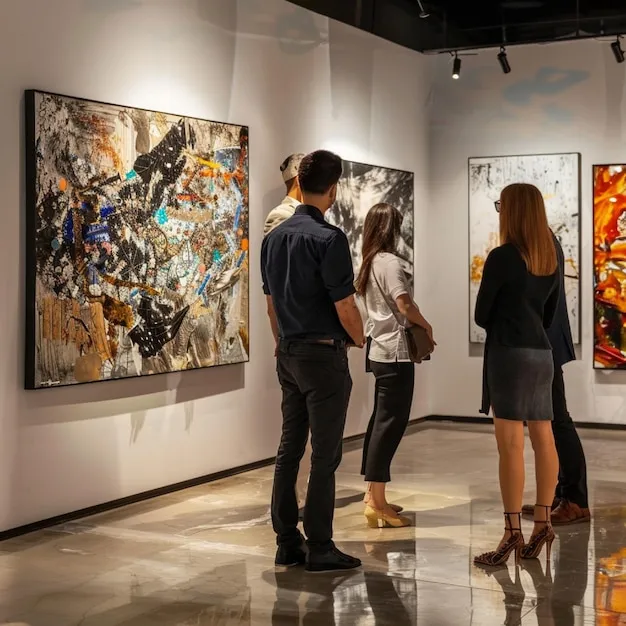
Photo: affluent patron art studio visit meaningful conversation contemporary art, via images.stockcake.com
Consider two individuals of comparable net worth, moving through comparable social worlds in, say, the Upper East Side of Manhattan or the hills above Bel Air. The first has spent the past decade assembling a life that reads, at a glance, as a catalog of correct choices: the right address, the right labels, the right club memberships, the right art on the walls—art that is recognizable, that has been vetted by auction records and critical consensus, that announces its own value the moment a visitor enters the room.
The second has spent those same years doing something harder to articulate. She has spent weekends in conversation with a philosopher-in-residence at a small Vermont college. She has directed significant funds toward a Black ceramicist working in Birmingham, Alabama, whose practice is rooted in a local tradition of craft that predates the Civil War and whose work has never appeared in a major auction. She has completed a three-year study of classical Arabic, not for professional utility but because she believed the language would teach her something about the nature of time. She has funded a fellowship program for science journalists at a moment when that particular form of expertise seemed to be disappearing from public life.
In the social world they share, there is no longer any ambiguity about which of these two individuals commands more genuine admiration.
The Exhaustion of the Legible
To understand why this shift is occurring, it helps to understand what preceded it—and what, ultimately, made the old model feel insufficient to those who had mastered it.
For generations, luxury operated as a language of legibility. Its function was communicative: to signal, through objects and affiliations that carried shared cultural meaning, one's position within a hierarchy. The logic was essentially semiotic. The Hermès bag, the Hamptons compound, the table at the restaurant that didn't take reservations—each element in the composition was chosen because it could be read, because it would be read, by anyone fluent in the vocabulary of American affluence.
The problem with legible languages is that they can be learned. And over the past two decades, the vocabulary of visible luxury has been acquired—through aspirational media, through the democratization of brand access, through the sheer proliferation of ostensibly exclusive goods—by audiences far broader than the original intended readership. When the symbols become widely available, their capacity to distinguish diminishes. The grammar of conspicuous consumption begins to feel, to those who pioneered it, like a dialect everyone now speaks.
What cannot be replicated at scale is interiority. The depth of a practice. The specificity of a conviction. The particular texture of a life shaped by genuine engagement with ideas, art, and human complexity rather than by the accumulation of approved objects.
The New Patronage: Funding What the Market Ignores
Perhaps nowhere is this reorientation more visible than in the realm of cultural patronage, where a growing cohort of wealthy Americans is deliberately directing resources away from the celebrated and toward the overlooked.
The established pattern of philanthropic giving in the arts has long favored institutions and artists already validated by critical and commercial consensus. Major museums, landmark retrospectives, artists whose auction records provide a kind of implicit guarantee—these have historically attracted the largest donations and the most prominent donor recognition. The gift confirmed status; the status confirmed the gift.
What is emerging now is a different logic entirely. The collectors and patrons who command genuine cultural credibility in 2024 are those who found the artist before the museum did, who funded the institution when it was still proving itself, who supported the form of practice—a particular approach to documentary filmmaking, a regional literary tradition, a mode of craft that exists outside the dominant market—because they believed in it, not because believing in it was safe.
In cities like Chicago, Houston, and Philadelphia, this impulse is reshaping local cultural ecosystems in ways that national art media has only begun to register. Private collectors are establishing residency programs in neighborhoods where institutional presence has been historically sparse. Donors who could write a check to a major symphony are instead funding chamber music programs in rural communities, or commissioning new work from composers whose idioms fall outside the concert hall's traditional comfort zone.
The motivation, as many of these patrons describe it, is not altruistic in any simple sense. It is about being genuinely moved—about having one's understanding of what is possible in a given art form genuinely enlarged—rather than merely affirmed.
Spiritual Depth as Social Capital
Equally striking is the growing prestige attached, in affluent American circles, to serious spiritual and contemplative practice. Not the performative wellness that has been a fixture of luxury culture for the better part of a decade—the Himalayan salt chambers and the sound bath retreats that function primarily as content—but something more demanding and less photogenic.
The Jesuit retreat that requires participants to observe near-total silence for eight days. The intensive Vipassana course in a converted farmhouse in rural Massachusetts, where attendees surrender their devices and submit to a schedule of meditation that begins before dawn. The years-long study of Kabbalah with a scholar in Crown Heights, Brooklyn, undertaken not as a celebrity affectation but as a genuine intellectual and spiritual inquiry.
These practices share a quality that distinguishes them from their more marketable counterparts: they resist commodification. They cannot be adequately conveyed in a social media post. They demand sustained commitment rather than occasional indulgence. And they produce, in those who undertake them seriously, a quality of presence and depth that is immediately recognizable to others who have done the same work—which is to say, they create their own community of recognition, one that operates entirely outside the usual mechanisms of status display.
What You've Made Possible
Underlying all of these expressions—the unconventional patronage, the serious contemplative practice, the investment in niche intellectual communities—is a common thread: the desire to be identified not by what one has acquired but by what one has enabled, cultivated, or become.
This is a more demanding form of identity construction than the acquisition of objects, precisely because it cannot be delegated entirely to wealth. Money can fund the fellowship program, but it cannot supply the judgment required to design one that actually works. Money can pay for the retreat, but it cannot generate the discipline to sit with discomfort for eight days without distraction. Money can acquire the overlooked artist's work, but it cannot manufacture the genuine aesthetic response that makes the acquisition meaningful rather than merely strategic.
In this sense, the shift from conspicuous consumption to conspicuous meaning represents not a rejection of wealth's role in a well-lived life but a more sophisticated understanding of its limits. The individuals navigating this terrain most gracefully are those who have grasped that the most interesting things money can do are the things it does quietly—enabling, supporting, making possible—while the life itself is shaped by something that no amount of money, on its own, can buy.