Proof of Origin: The Race to Own the Most Compelling Story in Luxury
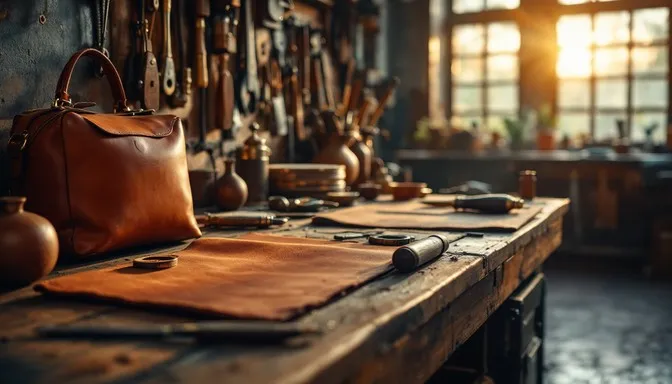
Photo: luxury artisan craftsman workshop leather goods heritage atelier, via images.stockcake.com
There is a particular kind of satisfaction that comes from holding an object whose entire biography you can trace. Not simply knowing that a handbag was made in France or that a timepiece carries a Swiss hallmark, but understanding the specific valley where the leather was tanned, the name of the atelier family that has supplied the house for four generations, and the precise technique—passed through apprenticeship rather than instruction manual—that gives the stitching its characteristic tension. For a growing segment of ultra-high-net-worth Americans, this depth of knowledge has become the defining metric of value.
The luxury market is responding with extraordinary investment. In the past three years alone, major houses across fashion, spirits, jewelry, and home goods have poured resources into what industry analysts are now calling "heritage infrastructure"—a constellation of brand historians, documentary film units, archival restoration programs, and immersive origin experiences designed to transform provenance from a footnote into the primary commercial argument.
The Collapse of Exclusivity as a Sufficient Proposition
For decades, luxury operated on a relatively simple logic: scarcity plus aspiration equals premium pricing. Limited availability, recognizable insignia, and the social signal of a name were enough to command exponential margins. That equation, while not entirely obsolete, has become insufficient for the most sophisticated tier of consumer.
"The client who is spending at the highest levels has, in many cases, already acquired the recognizable things," observes one luxury market analyst who advises several heritage European houses on their American market strategy. "What they are now seeking is not another trophy. They are seeking a relationship with an object—a sense that what they own carries genuine weight in the world."
This shift is measurable. Auction results over the past five years consistently show that lots accompanied by robust documentation—letters of commission, original workshop sketches, photographic evidence of the maker's process—outperform comparable undocumented pieces by margins that sometimes exceed forty percent. The premium is not merely sentimental. It reflects a sophisticated understanding that authenticity, properly substantiated, is a finite resource in a market increasingly crowded with convincing imitation.
What "Origin Story" Actually Means at This Level
The phrase risks sounding like marketing shorthand, but the investments being made suggest something more structurally serious. One storied American whiskey producer recently commissioned a two-year archival research project to reconstruct the precise grain sourcing and distillation practices of its nineteenth-century founders—not for regulatory purposes, but to inform a limited release and the accompanying collector's documentation that would accompany each bottle.
Similarly, a renowned New England textile house has partnered with a university anthropology department to catalog the regional wool traditions that informed its founding weaves, producing both a scholarly monograph and a series of intimate client experiences at its original mill site. Guests—by invitation only—observe the process from raw fiber to finished cloth, guided by craftspeople whose family connections to the mill span multiple generations.
"There is a profound difference between being told a story and witnessing its evidence," notes one private collector based in the Pacific Northwest, whose acquisitions span American studio furniture, indigenous textile arts, and small-batch spirits. "When I can stand in the room where something was made, speak with the person who made it, and hold the object itself—that convergence creates a kind of certainty that no amount of marketing copy can replicate."
The Verification Economy
As demand for authenticated provenance intensifies, an entire supporting industry has emerged to meet it. Independent brand historians—academics and cultural researchers who specialize in corporate genealogy—command significant fees to audit and document a house's claims. Blockchain-based provenance platforms, once associated primarily with fine art, are being adopted by luxury goods producers to create immutable records of material sourcing and maker identity. Third-party craft certification bodies are proliferating, offering what amounts to a credibility imprimatur for brands willing to submit their production processes to external scrutiny.
The stakes are correspondingly high. A house whose origin narrative is found to be embellished—whose "family atelier" turns out to be a recent acquisition rather than a generational inheritance—faces a reputational consequence disproportionate to the specific falsehood. The sophisticated consumer who prizes authenticity above all else regards deception not merely as a commercial betrayal but as a fundamental breach of the relationship that premium pricing is supposed to represent.
"Wealthy American collectors are extraordinarily well-networked," says one consultant who has guided several heritage brands through what she calls "provenance audits." "When a story doesn't hold up, that information travels faster than any press release. The investment in genuine transparency is, at this point, simply good risk management."
Craft as Cultural Contribution
Perhaps the most significant dimension of this trend is what it implies about how affluent Americans are choosing to position their consumption. Acquiring an object with a fully documented, ethically grounded origin story is increasingly understood not as an indulgence but as a form of cultural stewardship—a way of sustaining the traditions, communities, and skills that produce genuinely irreplaceable things.
This framing matters commercially. It allows the luxury purchase to carry moral weight in a cultural moment when conspicuous consumption faces increasing scrutiny. It also elevates the collector's own identity: to own something authentic is, by extension, to be someone who can recognize and value authenticity—a distinction that carries its own form of social currency among peers for whom conventional status signals have long since ceased to impress.
The houses that understand this dynamic are not merely selling goods. They are offering membership in a tradition—and the price of that membership, increasingly, is the willingness to prove that the tradition is real.