The Silence Premium: How America's Wealthiest Are Designing Life Beyond the Algorithm
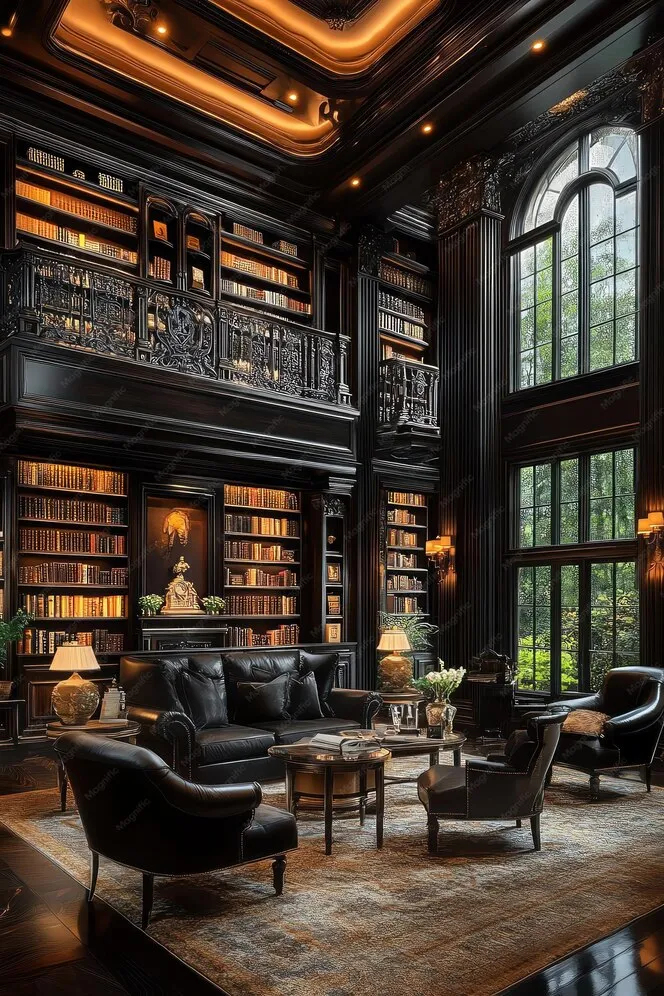
Photo: luxury private library reading room wood paneling warm lighting books, via img.freepik.com
There is a particular irony at the heart of contemporary luxury. The same individuals who built fortunes navigating digital markets, streaming platforms, and social networks are now spending extraordinary sums to ensure that none of those things can reach them at home. Not as an act of technophobia, but as one of supreme intentionality.
Among the country's most discerning private clients, the conversation has shifted. Where a bespoke home theater or a climate-controlled wine vault once signaled arrival, the new aspiration is considerably quieter—and considerably more difficult to achieve.
The Architecture of Absence
Designing a space that is genuinely, structurally offline is not as simple as switching off the router. For those committed to the concept, it begins at the level of the building envelope itself. Faraday caging—a technique borrowed from electromagnetic engineering—lines certain rooms with conductive mesh embedded within the walls, blocking all wireless signals: cellular, Wi-Fi, Bluetooth, and satellite. The effect is complete radio silence, not as a metaphor but as a measurable physical state.
Interior architects working at the highest residential tier report that requests for such rooms have increased meaningfully over the past three years. The spaces being commissioned range from single meditation alcoves to entire estate wings. One designer working primarily with clients in the Hamptons and the Hudson Valley describes receiving briefs that specify, almost clinically, the desired signal attenuation down to the decibel. "It used to be that clients wanted the fastest possible connectivity throughout every room," she notes. "Now the most demanding brief I receive is for a space where nothing connects to anything."
The materials involved are not inexpensive. Specialized copper mesh, acoustically engineered plasterwork, hand-milled hardwood shelving, and lighting systems that operate entirely on analog timers combine to produce environments that feel—and function—as though they exist in an earlier, unhurried era. The construction costs for a properly executed disconnected library or study can approach the budget of a small luxury apartment.
What They Are Reading There
The rooms being built are, in many cases, libraries—and not the decorative kind. Serious bibliophilic investment is accompanying the architectural trend. Private book consultants, a profession that has expanded quietly alongside the growth of the ultra-high-net-worth market, report clients assembling collections with genuine intellectual coherence: complete runs of mid-century American literary magazines, first editions of canonical philosophy texts, hand-bound volumes of poetry commissioned from independent presses.
The reading habits taking shape in these spaces tend toward the unhurried and the deep. Long-form narrative nonfiction, classical history, and literary fiction dominate. Several consultants note a particular appetite for works that reward sustained attention—the kind of reading that the fractured rhythms of digital life make effectively impossible. Proust is frequently mentioned. So is Gibbon. There is evident pleasure, among this cohort, in reclaiming the experience of reading a book from cover to cover without interruption.
Beyond books, these sanctuaries are being stocked with analog entertainment of a deliberately considered variety: vinyl record collections curated by music historians, chess sets crafted from semi-precious stone, correspondence stationery from heritage European houses. The common thread is materiality—the pleasure of objects that exist entirely in physical space and demand full sensory presence.
Disconnection as Cultural Statement
To understand why this trend carries such cultural weight, it helps to consider what it implicitly rejects. Hyper-connectivity was, for roughly two decades, the aspirational posture of the American elite. The ability to be reached anywhere, to respond instantly, to remain perpetually informed was coded as a mark of importance and relevance. The always-on executive was a figure of admiration.
The shift now underway represents a quiet but pointed repudiation of that posture. To step away—structurally, architecturally, by design—signals something quite different: that one's time is sufficiently valuable to protect from interruption, that one's inner life requires cultivation rather than constant external stimulation, and that the discipline to disconnect is itself a form of mastery.
This reframing has deep cultural roots. The American tradition of the gentleman scholar, the intellectual retreat, the country estate as a place of serious thought rather than mere relaxation—all of these serve as historical precedents that today's clients are, consciously or otherwise, invoking. There is a lineage being claimed, one that connects the disconnected library in Connecticut to the cabinet of curiosities, to the studiolo of the Renaissance, to the private reading room of the Enlightenment.
The Paradox of the Analog Premium
Perhaps the most telling detail of this entire movement is that the technology required to achieve genuine disconnection is itself cutting-edge. The electromagnetic shielding used in these rooms draws on research conducted for military and aerospace applications. The climate control systems preserving rare book collections employ sensors of considerable sophistication. The lighting automation that allows a room to feel entirely pre-digital is, in fact, governed by some of the most advanced residential control systems available.
This paradox does not appear to trouble those commissioning these spaces. If anything, it adds a layer of conceptual richness to the endeavor: one must understand and command the digital world fully in order to meaningfully transcend it. The retreat is earned, not inherited. The silence is chosen, not imposed.
There is also, it should be noted, a social dimension to these sanctuaries that extends beyond individual use. The disconnected estate or library has become a setting for a particular kind of gathering—small, invitation-only, conversation-centered. Dinners without phones. Reading weekends. Salons in the original sense of the word. The absence of devices becomes a shared protocol, a form of collective agreement that elevates the quality of human exchange in the room.
The New Measure of Refinement
Luxury has always been, at its core, about scarcity. What is rare becomes precious; what is difficult to achieve becomes desirable. In an era when connectivity is ubiquitous and attention is the most eroded resource in modern life, genuine stillness has become genuinely scarce.
The individuals building these spaces understand this with clarity. They are not rejecting the modern world—they are engaging with it on their own terms, from a position of deliberate choice rather than passive immersion. The library without a signal, the study where no notification can arrive, the estate where the evening passes in conversation and candlelight: these are not nostalgic fantasies. They are the considered expressions of people who have looked carefully at what the connected life costs, and decided to spend their most valuable resource—time and attention—differently.
In that sense, the silence premium is not a trend. It is a philosophy. And like all enduring philosophies of the good life, it is built to last.