The Hand Behind the Work: How Affluent Collectors Are Trading Galleries for Direct Relationships With Makers
For most of the twentieth century, the grammar of serious collecting followed a recognizable structure. Objects moved from maker to gallery to collector through a series of intermediaries who added context, authentication, and market value at each stage of the journey. The collector's role was essentially curatorial—selecting from what the market presented, guided by advisors whose expertise lay in identifying quality and predicting appreciation.
That structure, elegant and efficient as it was, has begun to feel insufficient to a particular class of American collector. Not insufficient in terms of quality—the gallery system continues to surface extraordinary work—but insufficient in terms of meaning. What the system was never designed to provide was proximity to the act of making itself. And it is precisely that proximity that the most thoughtful collectors are now seeking.
The Limits of the Finished Object
To understand why this shift is occurring, it helps to consider what a finished object, presented in a gallery or offered at auction, actually communicates. It communicates the result of a creative process. What it does not communicate—cannot communicate, by its nature—is the process itself: the decisions made and unmade, the problems encountered and solved, the particular intelligence that a skilled maker brings to the negotiation between material and intention.
For collectors whose interest in craft is genuinely intellectual rather than merely acquisitive, this gap has always been present. What has changed is that a growing number of them are now willing to reorganize their collecting practice around closing it. They are commissioning work rather than acquiring it. They are visiting studios rather than previewing at fairs. They are funding research and material exploration that may or may not result in objects they will ever own. And they are building relationships with makers that extend across years and, in some cases, decades.
The result is a collecting practice that looks, in important ways, more like patronage than purchasing—and that is, for many of these collectors, precisely the point.
A Different Kind of Acquisition
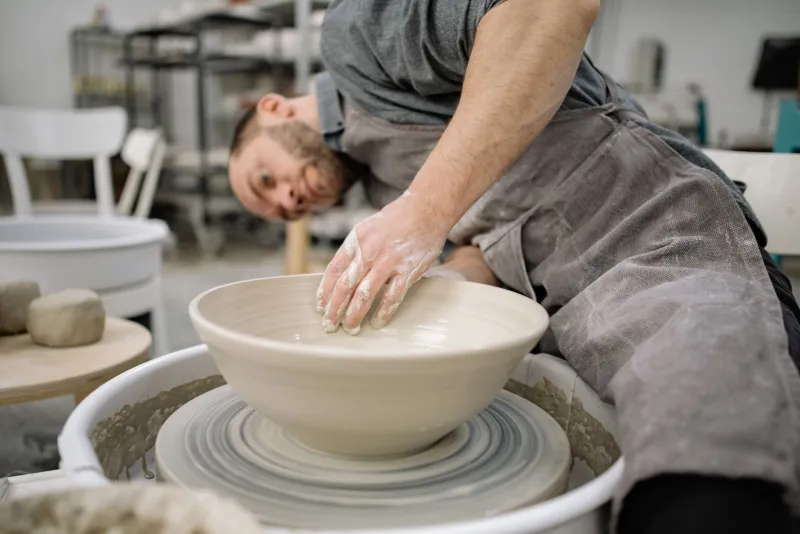
The mechanics of direct maker relationships vary considerably depending on the collector and the artisan involved. At one end of the spectrum are straightforward bespoke commissions: a collector identifies a ceramicist, weaver, or furniture maker whose work they admire and approaches them directly to discuss a specific piece tailored to particular requirements. The exchange is personal, the object is singular, and the collector acquires something that exists nowhere in the secondary market because it was never intended for one.
At the other end of the spectrum are arrangements that more closely resemble research fellowships. A collector with a serious interest in, say, traditional Japanese joinery techniques or the revival of American hand-papermaking might fund an artisan's extended investigation into a particular material or method—not with any expectation of receiving specific objects in return, but with the understanding that they will have access to the process and a first relationship with whatever work emerges from it.
Between these poles lies a wide range of hybrid arrangements: studio visits that evolve into ongoing correspondence; material-sourcing partnerships in which collector and maker travel together to understand where raw materials originate; collaborative design processes in which the collector's aesthetic preferences are tested against the maker's technical knowledge over the course of months.
What all of these arrangements share is an emphasis on relationship over transaction—and a willingness to accept that the value being exchanged is not reducible to the market price of any finished piece.
The Story as the Object
There is a phrase that recurs in conversations with collectors who have embraced this approach: they speak of wanting to own the story, not just the thing. It is a formulation worth taking seriously, because it points to something genuine about what distinguishes this collecting practice from more conventional approaches.
When a collector commissions a piece of furniture from a maker who sources his timber from a specific forest in Vermont and finishes it using techniques he spent three years learning from a retired craftsman in rural Japan, the resulting object carries a narrative that no gallery catalogue could fully contain. The collector who was present for some part of that process—who visited the forest, who met the craftsman, who watched the finishing work progress across several studio visits—possesses something that cannot be purchased at any price: direct experience of the intelligence and care embedded in the object.
This is not sentiment. It is a sophisticated understanding of where value actually resides in handmade work. The most compelling objects in the history of decorative arts have always been compelling in part because of what we know about their making. The direct relationship model simply brings that knowledge into the collector's own experience rather than leaving it to historians to reconstruct.
Implications for the Broader Craft Economy
The consequences of this shift extend well beyond the collecting community. When affluent patrons begin funding makers directly—commissioning experimental work, underwriting material research, providing the financial stability that allows an artisan to decline commercial compromises—they alter the conditions under which craft knowledge develops and survives.
Many of the most technically sophisticated craft traditions in America are sustained by a small number of practitioners operating under considerable financial pressure. The entry of serious private patrons into direct relationships with these makers does not merely support individual careers; it creates the conditions under which rare skills can be passed on, refined, and extended into territory that purely market-driven production would never explore.
For the collectors involved, this broader contribution is not incidental to their practice. It is, increasingly, central to it. The most thoughtful among them understand that they are not simply acquiring beautiful objects—they are participating in the preservation and evolution of a form of human intelligence that the industrial economy has never found it profitable to protect. That understanding, more than any single piece in their collections, is what defines the new grammar of serious collecting at the highest level.